

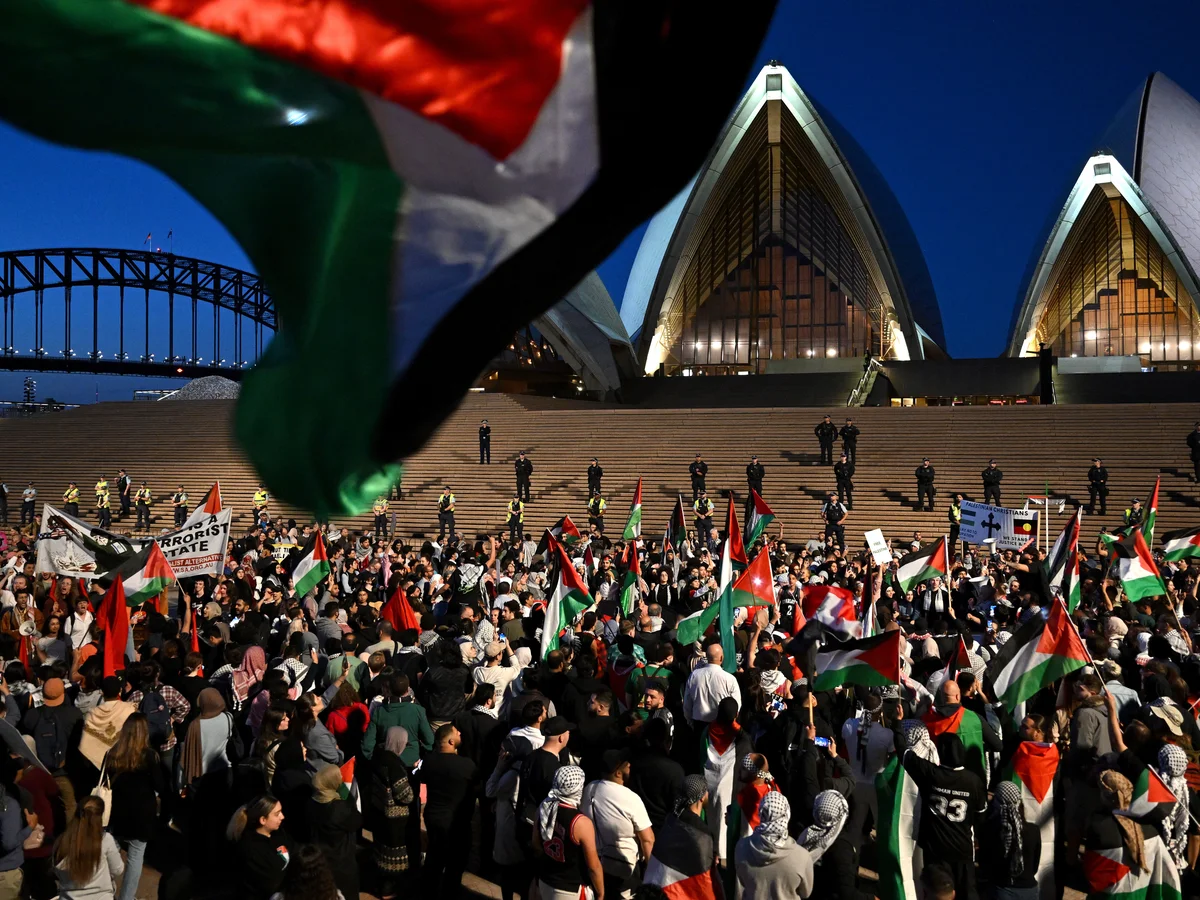
The Supreme Court has delayed its decision on a pro-Palestinian protest to take place on the Sydney Harbour Bridge from Sunday afternoon.
The Palestine Action Group lodged the application for 10,000 people to conduct a protest march across the bridge, in solidarity with the Palestinian people and to highlight the humanitarian crisis in Gaza.
Earlier this week, NSW Premier Chris Minns refused to grant the group permission — citing advice that authorities were not given enough time to safely organise resources for the protest — and NSW Police took court action to categorise the march as unlawful and unauthorised.
NSW has a permit system that allows protest participants to block public roads and infrastructure, but police can go to court to deny permission.
Organisers and NSW Police present their cases
Spectators overflowed in the Supreme Court in Sydney on Friday, with journalists and members of the public finding spaces to sit on the floor.
Representing the state police, Lachlan Gyles SC argued they would not be able to maintain a safe environment if the protest was authorised and that closing the bridge was not reasonable in under a week’s notice.
“This is really unprecedented in terms of scale, the level of risk, the lack of time to prepare,” he told the court.
He accused the organisers’ spokesman, Josh Lees, of ignoring his duty of care to public safety.
Under cross-examination, acting assistant police commissioner Adam Johnson raised the possibility of a crowd crush.
“I’m personally concerned about that,” he said.
“We (Palestine Action Group) want to work with them to facilitate a march over the bridge that is safe and peaceful,” Lees said.
The group’s barrister Felicity Graham told the court it would be safer for police to authorise the protest, as people would march regardless of Justice Belinda Rigg’s decision.
“A prohibition order may well increase the number of people who attend the protest, and exacerbate the potential for unrest and violence,” she said.
Ahead of the ruling, Lees said the organisation was open to delay the rally if the police are willing to work with them.
Police would retain certain powers to address antisocial behaviours, even if the protest is authorised, Graham said.
She said the groundswell of support for the march, including from members of parliament, organisations and high-profile figures, must also be taken into account.
Politicians set to join the march
Several trade unions had endorsed the march, while 15 state politicians — including five NSW Labor MPs — said they were planning to march on Sunday.
One of the Labor politicans, Stephen Lawrence, said in a social media post on Friday morning that “the event is now absolutely inevitable, largely because of the way it has been mishandled”.
Minns, who has blamed demonstrators for draining police resources for nearly two years in their facilitation of weekly protests in the city’s centre, said earlier in the week that he “cannot allow Sydney to descend into chaos”.
The bridge has previously been shut, including for a reconciliation rally in 2000 which attracted more than 250,000 people, a World Pride event with Prime Minister Anthony Albanese’s participation and a Hollywood film production.
Among other objectives, protesters aim to shine a spotlight on the humanitarian crisis that has engulfed the Gaza Strip.
Since 7 October 2023, the Gaza health ministry has recorded 156 deaths from starvation and malnutrition, most of them in recent weeks, including at least 90 children.
Hamas killed 1,200 people and abducted 251 to Gaza in its October 7 attack on southern Israel, according to Israeli tallies.
Nearly 60,000 Palestinians have been killed in Israel’s subsequent campaign against Hamas in Gaza, according to Palestinian health officials.
Confronted by rising international outrage over images of starving children, Israel said it would halt military operations for 10 hours a day in parts of Gaza and designate secure routes for convoys delivering food and medicine.