
Interim govt led by Dr Yunus marks one year in office

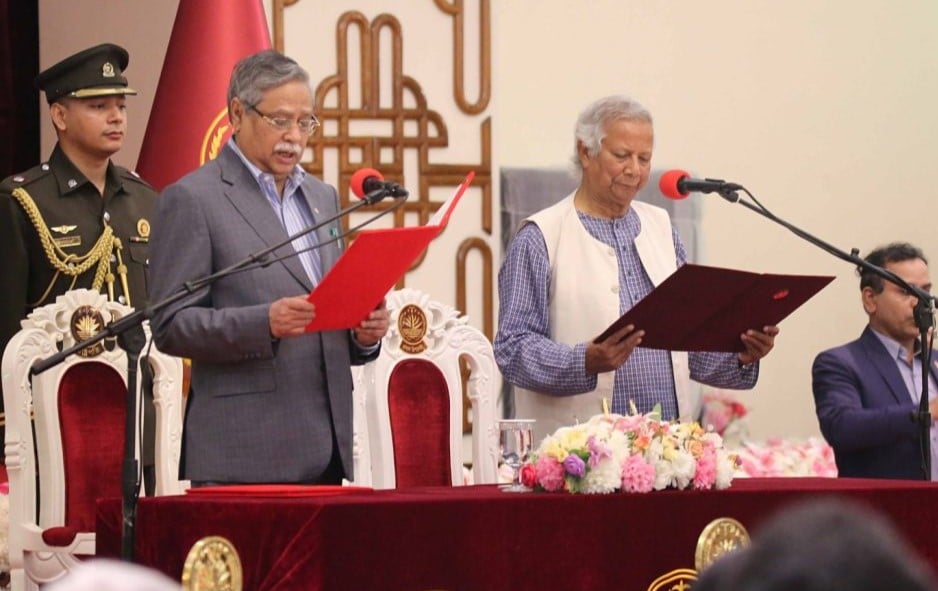
Bangladesh desk: The interim government led by Nobel Laureate Professor Dr Muhammad Yunus completes its first year in office today, August 8, 2025.
The administration assumed power exactly a year ago following the ouster of Sheikh Hasina’s regime in a massive popular uprising on August 5, 2024, which left many students and civilians dead or injured.
Since taking office, the interim government has launched a wide range of reform initiatives aimed at bringing positive change to the country’s political, economic, and social landscape. In honour of those who lost their lives in the July uprising, the government has focused on reshaping the electoral process, strengthening governance, ensuring judicial independence, restoring press freedom, improving law and order, and delivering justice for the victims of the mass protests.
Marking the first anniversary of the uprising, the government presented the July Declaration to the nation on August 5. The July Charter, a more detailed reform framework, is nearing completion following rounds of dialogue between political parties and the National Consensus Commission.
In a televised address on August 5, Chief Adviser Muhammad Yunus announced that the next national parliamentary elections would be held in February 2026, ahead of the holy month of Ramadan. The following day, his office formally requested the Election Commission to begin preparations for the polls. The Chief Adviser’s Press Wing later confirmed that all procedural steps to initiate the election process had been completed.
Following a meeting at the Nirbachan Bhaban in Dhaka today, Election Commissioner Brigadier General Abul Fazal Md Sanaullah (Retd) told the media that the election schedule will be announced in the first half of December this year.
Over the past year, the interim government introduced multiple reforms across critical areas of national interest.
The government has formed a number of reform commission including Electoral Reform Commission, Police Reform Commission, Judiciary Reform Commission, Anti-Corruption Reform Commission, Public Administration Reform Commission, Health Reform Commission, Mass Media Reform Commission, Labour Rights Reform Commission and Women Affairs Reform Commission.
The commissions submitted their reports and the government also took many steps as per the recommendations of the commissions.
On the economic front, the government has made notable progress. Inflation, which was a major concern at the beginning of its term, fell to 8.48 percent in June — the lowest in nearly three years. Dr Yunus attributed this to prompt action in response to flood-related disruptions in agricultural production and to efforts that reduced the role of middlemen in the market. He expressed confidence that food inflation would fall further to six percent by December.
The interim government’s efforts have also contributed to renewed confidence among expatriate Bangladeshis. Remittance inflows reached a record $30.33 billion in the last fiscal year, while export earnings rose by about nine percent. As a result, the value of the taka has started to strengthen against the dollar after many years of decline.
Dr Yunus noted that Bangladesh has repaid $4 billion in interest and principal on foreign loans in the past 11 months — the highest amount ever. Despite these repayments, foreign exchange reserves are on the rise, reflecting growing economic stability.
As the interim government enters its second year, its focus remains on ensuring a smooth democratic transition through the 2026 elections, while continuing the reforms necessary to build a more accountable, inclusive, and resilient Bangladesh.